UFT slams Hochul’s embrace of voucher deal

UFT union partners, including NYSUT and PSC-CUNY, which represents CUNY educators, hold signs in support of public dollars for public education.
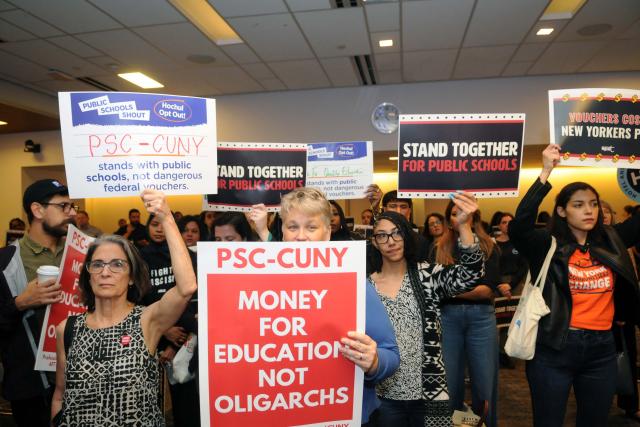
The UFT is vowing to fight back after Gov. Kathy Hochul announced on Oct. 9 that she would embrace a federal voucher scheme supporting private school tuition that was included in President Donald Trump’s “One Big Beautiful Bill.”
UFT President Michael Mulgrew slammed Hochul’s decision to opt New York State into the program, which incentivizes individuals to donate to scholarship-granting organizations that support private school tuition. Donors can also support after-school programs, test preparation and tutoring. In return, taxpaying donors in states that have opted-in can claim up to $1,700 in federal tax credits beginning in January 2027.
Mulgrew vowed to “work with our allies to try to roll back this policy and protect our classrooms.” He added, “Giving up local control of public education to the federal government through the Trump administration’s private school voucher scheme is a failure of leadership.”
According to estimates from Congress’ Joint Committee on Taxation, the program would redirect $3 billion in federal tax dollars to private schools through scholarship-granting organizations by 2029.
“Vouchers exploit and explode state budgets,” AFT President Randi Weingarten said during a Sept. 16 anti-voucher rally at UFT headquarters. UFT members were joined by fellow unionists, elected officials, the NAACP and other organizations in speaking out against the program. Leaders from the AFL-CIO and the A. Philip Randolph Institute concurred with Weingarten, characterizing the voucher plan as a drain on public school funding and a handout for the affluent.
“We’ve seen this before,” said President L. Joy Williams of the NAACP of NY, drawing a connection between the “voucher scheme” and similar programs used to continue segregation in schools despite the landmark Brown v. Board of Education Supreme Court case of 1954.
Mulgrew agreed, pointing out that in states with voucher programs, “We have seen our communities resegregated, and we have seen the haves and the have-nots grow even farther apart.”
Weingarten described what has already happened in states that embraced voucher programs. In Arkansas, 95% of voucher recipients were already attending private schools. In Arizona, 71% of recipients never attended public schools in the first place. “It’s not about school choice,” she said. “It’s meant to help people who are already in private schools.”
The redirection of federal funds in support of private schools puts all children at risk, especially the most vulnerable, said speakers at the event. “Private schools can turn anyone away,” said NYSUT President Melinda Person. “But we educate everyone. The child with disabilities. The child that’s an English language learner. The child living in poverty.”
For Mulgrew, educating everyone is exactly the point of public education. “All children are ours,” he said. “And that’s how it should be.”