Social study of old New York

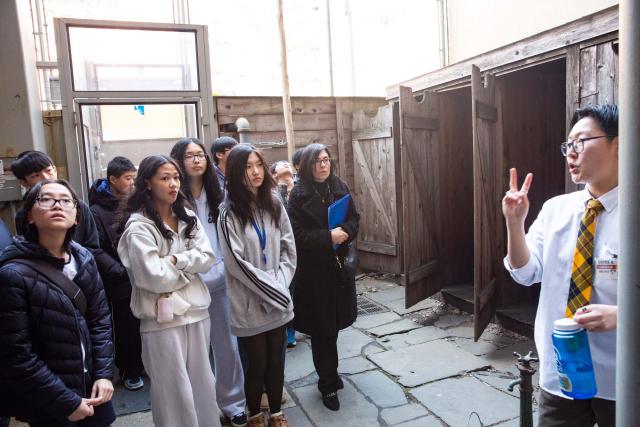
Students learn that up to 120 people living at 97 Orchard St. shared four bathrooms and one communal water spigot outside.

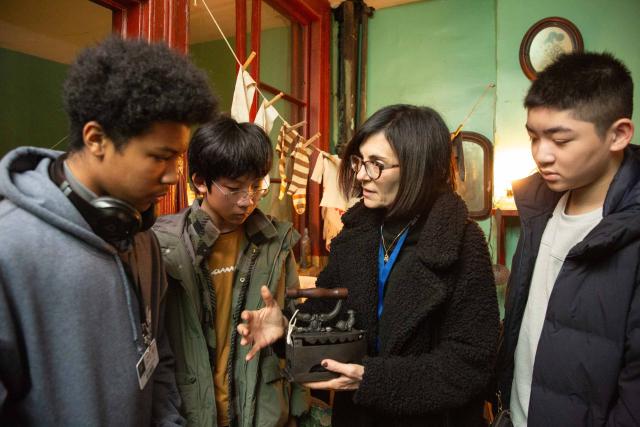
Monte and her students handle an iron that the family would have used for its own clothing and in the tailoring business.

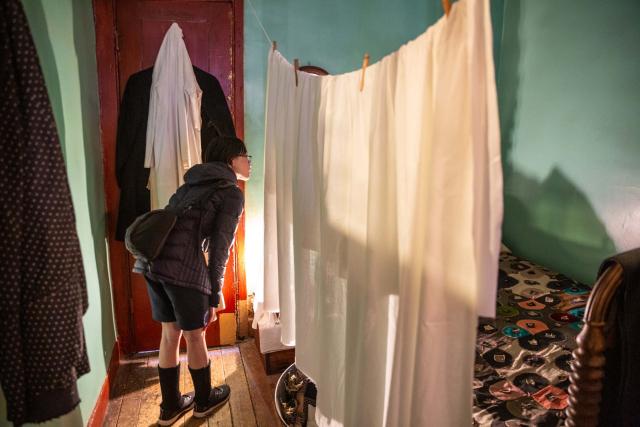
In the re-created apartment of the Levine family at the turn of the 20th century, a student peeks behind a curtain in the bedroom where the parents would have slept.
For the 8th-graders from PS/IS 119 in Queens, the three-room, 325-square-foot walk-up in the Lower East Side tenement building was surprisingly not as cramped as they thought it would be.
However, as was explained by an educator with the Tenement Museum where the apartment was showcased, the walk-up where Harris and Jenny Levine and their children lived in 1902 also served as a small garment factory for Harris, a ladies’ tailor.
“Picture what this room would have looked like when the husband was running his garment factory from Sunday to Friday, the Jewish work week,” Grace Ahn told the students, adding that the couple’s three (ultimately, five) children would have been present, too.
The museum, which opened in 1988, tells the stories of immigrants, migrants and refugees who arrived in New York City between the 1860s and the 1970s. Visitors can tour historically re-created spaces in restored tenements. Each program highlights one or more real immigrant or migrant families from different eras of New York City history, while exploring universal themes of cultural identity, community and adaptation through the stories of “ordinary” people.
Kristina Monte, who teaches 8th grade at the school in Queens’ Glendale neighborhood, said the trip humanized photos taken by journalist Jacob Riis, which the students had studied in their unit on the industrial revolution and the working and living conditions and immigration of the late 1800s. Riis’ late 19th-century work brought attention to impoverished conditions and disease in city tenements.
“When 14-year-olds are asked to describe what they see in the photos, they say things like ‘cramped,’ ‘dirty,’” Monte said. “But now, what Grace made them think about is the sense of community, the sense of expanding your heritage and living and learning and eating with other people.”
Claire, one of Monte’s students, said the tour — “Tenement Women: 1902,” highlighting challenges and changes Jewish mothers faced — changed how she perceived the tenements. “Based on what we learned in the museum, you see that it’s actually like a community,” she said.
Other classes from the school visited the museum that day, too, and went on separate tours of different living spaces.
The 97 Orchard St. building that Monte’s students visited was built in 1863 and housed a total of about 7,000 people before it was condemned as a living space in 1935 due to new housing laws. Small businesses continued to operate there until the museum opened.
The 8th-graders saw four rudimentary latrines and a communal water spigot outside the building that about 120 people would have shared.
“This is where people got to meet their neighbors for the very first time and that’s important because this is during a time when the government doesn’t offer you anything, so you have to depend on your neighbors and community,” Ahn told the students.
Upstairs, they toured the re-created apartment of the Levines, who immigrated to the U.S. from what is now Poland. It had a bed for the parents and a crib. Other children would have slept in the parlor or possibly on the fire escape or roof during hot weather. In winter, everyone slept in the kitchen for warmth.

Teacher Kristina Monte (second from left) and her students are shown artifacts, including an advertisement for a palm reader and a ticket to synagogue for the high holy days.

They stood in the Levines’ parlor, which had dress pieces, needles, thread and other sewing implements in addition to daily living items. In the kitchen, they handled an iron that would have been heated with coal for Jenny and her husband’s clothes presser to share.
Students also learned about the Lustgardens, a Jewish family from the Austro-Hungarian Empire who lived there during that era and ran a kosher butcher shop on site.
They viewed other objects that would have belonged to residents, such as the first Yiddish cookbook published in America, marbles, a palm reader ad and a ticket for synagogue on the high holidays.

Several 8th-graders from PS/IS 119 in Glendale, Queens, raise their hands when asked how many of them know someone who is an immigrant.

These families were among those who fled their homelands to escape persecution, Ahn said. They came with a “sense of preservation” for their traditions, language, culture and religion and settled in communities where they could continue them. While individual circumstances are unique, the reasons people migrate are universal and continue to this day, Ahn said, including escaping persecution, war and famine and seeking job opportunities, education and a better life.
The museum developed the spaces by looking at U.S. Census records and other documents, such as court papers, city directories, museum photos and Ellis Island records, and by contacting descendants. The Levine family donated sewing shears and photos. The museum works with historians to continually update research.
“We are a storytelling museum,” Ahn said. “Objects help us tell these stories.”
Students from kindergarten through grade 12 can tour historically re-created spaces in tenements to learn the stories of 120 working-class families, including Black, Eastern European Jewish, Chinese, German, Greek, Irish, Italian, Puerto Rican and Russian families. The museum also offers neighborhood walking tours, virtual visits and costumed interpreter programs. The cost for New York City public schools ranges from $120 to $600, depending on group size, including chaperones, and half price for Title 1 schools. Group reservations are required and must be made at least two weeks in advance. For more information, visit tenement.org.