UFT backs $10K boost for paras
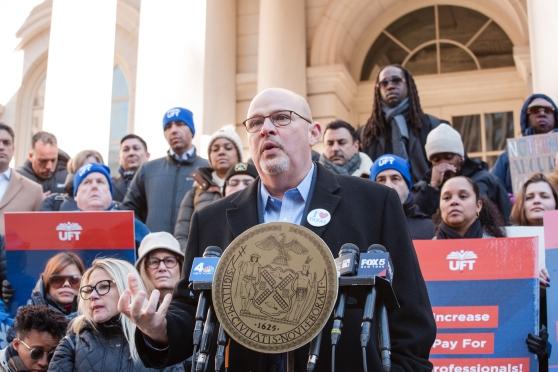
UFT President Michael Mulgrew, flanked by Paraprofessionals Chapter Chairperson Priscilla Castro (right), says low pay is fueling a paraprofessional shortage.

UFT President Michael Mulgrew joined City Council Education Committee Chair Rita Joseph and other Council members outside City Hall on Jan. 30 to announce proposed legislation that would provide a permanent annual payment of $10,000 or more to full-time paraprofessionals.
The payout, which would be created outside collective bargaining, would address the serious shortage of paraprofessionals, who play a critical role in special education. New York City schools started the year with more than 1,600 paraprofessional vacancies, according to a chapter leader survey.
“We’re in a crisis. Even if we can hire a paraprofessional, they’re not staying because of the pay,” said Mulgrew.
He called the proposed payment a “respect check,” with a nod to the RESPECT campaign that the union launched in December 2024.
“Our city cannot function without paraprofessionals,” he said.
The union’s online petition urging City Council members to support the proposed legislation quickly garnered more than 52,000 signatures in its first five days.
Mulgrew said paraprofessionals’ wages have fallen further and further behind as a result of pattern bargaining, which shortchanges paraprofessionals and other low-wage workers. A 3% increase for a first-year paraprofessional, whose salary is $31,787, translates to $954 more in their pocket, while a principal earning the maximum salary of $216,747 receives $6,500.
Mulgrew said that city and Department of Education officials privately admit that paraprofessionals are underpaid. “The city recognizes that they cannot recruit or retain paraprofessionals because their salaries are too low, but they refuse to do anything about it except ask teachers and guidance counselors and everybody else to pay for it,” he said.
The proposed legislation would use a “para pay index” to reduce the growing wage gap. The formula would be based on the gap between the starting salary for paraprofessionals and the salary of the highest-paid principals. The annual amount would fluctuate from year to year but would not dip below $10,000.
John Kamps, the 2nd vice chairperson of the Paraprofessionals Chapter, said paraprofessionals struggle to get by on their current salaries. “We have a lot of paras who are a paycheck away from being evicted,” he said.
Joseph, a former city public school teacher, noted how expensive it is to live and raise a family in New York City. “If we want New Yorkers to stay here, we have to address that affordability and retain that workforce,” she said.
The extra money also would recognize the important work that paraprofessionals do, Kamps added. “There is nothing that a kid can accomplish in that classroom that a paraprofessional’s not really tied to,” he said.
Labor Committee Chair Carmen De La Rosa, a co-sponsor of the legislation, said paraprofessionals are not being compensated for the level of care they provide. “Sixteen-hundred vacancies is a crisis, and this is a crisis of mismanagement,” she said. “Why? Because we can solve this crisis with an investment.”
The annual checks would be supplemental payments and not pensionable because the City Council cannot increase regular wages for city workers. Substitute paraprofessionals would receive a prorated payment based on the number of days they worked.