Unplugged and reengaged

Students are talking to one another more, reading and playing board games like Uno and Connect 4 since the UFT-backed cellphone ban took effect this school year.
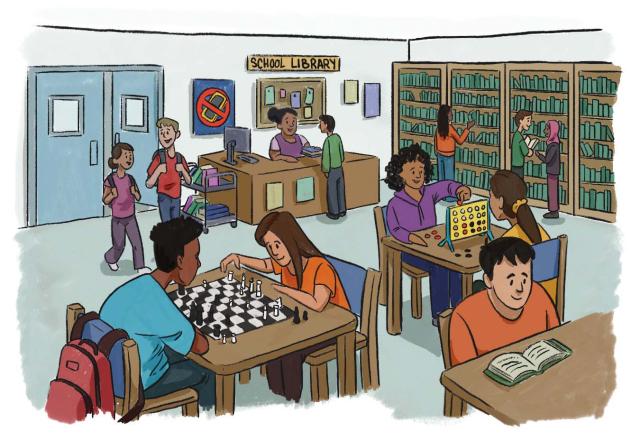
The state’s new UFT-backed cellphone ban is getting rave reviews from educators who say students are more engaged in class — and rediscovering “old-fashioned” pastimes like reading, playing board games and simply talking to one another.
Prior to the ban, which took effect at the start of the school year, art teacher Dan Wever of Sunset Park HS in Brooklyn said it was difficult to capture his students’ imaginations. He would lead his students in the intricate and detailed work of crafting clay masks, but students would quickly retreat into their phones.
Now? “They’re talking more in class, they’re comparing works with one another, they’re much more open to feedback and suggestions,” Wever said.
Wever’s colleague, school librarian Adalena Kavanagh, had tried introducing “analog Fridays” three years ago, but she couldn’t sustain interest. “Students were too seduced by their phones,” she said.
Since the statewide ban — which includes all internet-enabled devices — “students are checking out books at a frequency that I have not seen in 10 years,” Kavanagh said. “It’s really gratifying to see a culture of literacy blossoming again.”
Students have also taken a keen interest in board games, borrowing classics like Connect 4, Uno and Monopoly from the library.
“I need to have four to five decks of Uno on any given day,” she said. “I have one group of boys who play Monopoly every day.”
Uno has become a lunchtime favorite at New Utrecht HS in Brooklyn as well, said Chapter Leader Enrique Escribano, a 12th-grade English teacher and 24-year veteran.
Escribano’s students are engaging with literature in ways he hasn’t witnessed in years. “I just finished our Socratic seminar and the level of participation this year was just a different level,” he said. “The quality of research, the rebuttals, even the knowing of each other’s names. It’s been a long time since I have felt that kind of energy. It was really refreshing.”
That renewed energy, he said, comes from the safer, healthier environment created when cellphones are off-limits. Social media posts were a major source of disruption before the ban, Escribano said.
“Now, there are fewer opportunities for cyberbullying, or spreading the word and posting videos of fights,” he said. “That fuel is removed. That negative energy is removed. The ability to instigate is removed.”
At Boys and Girls HS in Bedford-Stuyvesant, which banned cellphones a decade ago, Chapter Leader Emilia Strzalkowska said the state law — which extends to all internet-enabled devices, including headphones — has made a noticeable difference.
“Kids are more in tune with one another and with what’s happening in class,” she said. “It keeps them more focused.”
Jessica Ferrara, a math teacher at Queens Technical HS in Long Island City, said she felt the impact of the ban immediately.
“On the first day, there was a lot more chatter in the hallways,” she said. “It was nice. The vibe was different.”
There’s also less conflict. “There’s a lot less drama — less ‘he said, she said,’ less seeing offensive stuff on social media or in mass texts,” Ferrara said.
At IS 125 in Woodside, Queens, ENL teacher Brad Ludwin said the ban has been especially beneficial for English language learners, who are now speaking more in English outside class.
“Students who are acquiring a new language really need to be able to focus on listening and speaking in the new target language,” he said. Without cellphones, “they can really concentrate.”
Lake Zebrowski, a history teacher at South Bronx Preparatory, said his middle schoolers are reconnecting socially. “Now they’re talking to each other, laughing, playing around at recess,” he said.
At the Washington Irving campus in Manhattan’s Union Square neighborhood, Tracy Karas, a library media specialist, said students are embracing old technology.
“A lot of kids are bringing in point-and-shoot cameras, old-school digital cameras, Polaroid instant cameras,” Karas said. “They’re still capturing their high school years, especially the seniors, but without their personal device as a distraction.”
The change has lifted teachers’ spirits, too.
“My joy in teaching has really been revitalized,” said Wever, a 12-year veteran. “It’s so much more pleasant to be able to speak to kids now without them retreating into their cellphones.”
The impact has been “dramatic,” said Escribano. “It’s the way learning is supposed to be.”