Special education gets the shaft
The Department of Education had hired 424 new substitute paraprofessionals and another 1,400 candidates were in the pipeline by early December after the UFT sounded the alarm about a severe special education staffing shortage that led to thousands of children not receiving legally required services.
UFT President Michael Mulgrew declared the city’s special education system broken at a Nov. 20 press conference and called on the DOE to ramp up its hiring. “We need to get this right: We need to get the hiring in place, we need to pay paraprofessionals more, we need to make sure we’re getting better supports in our schools,” he said.
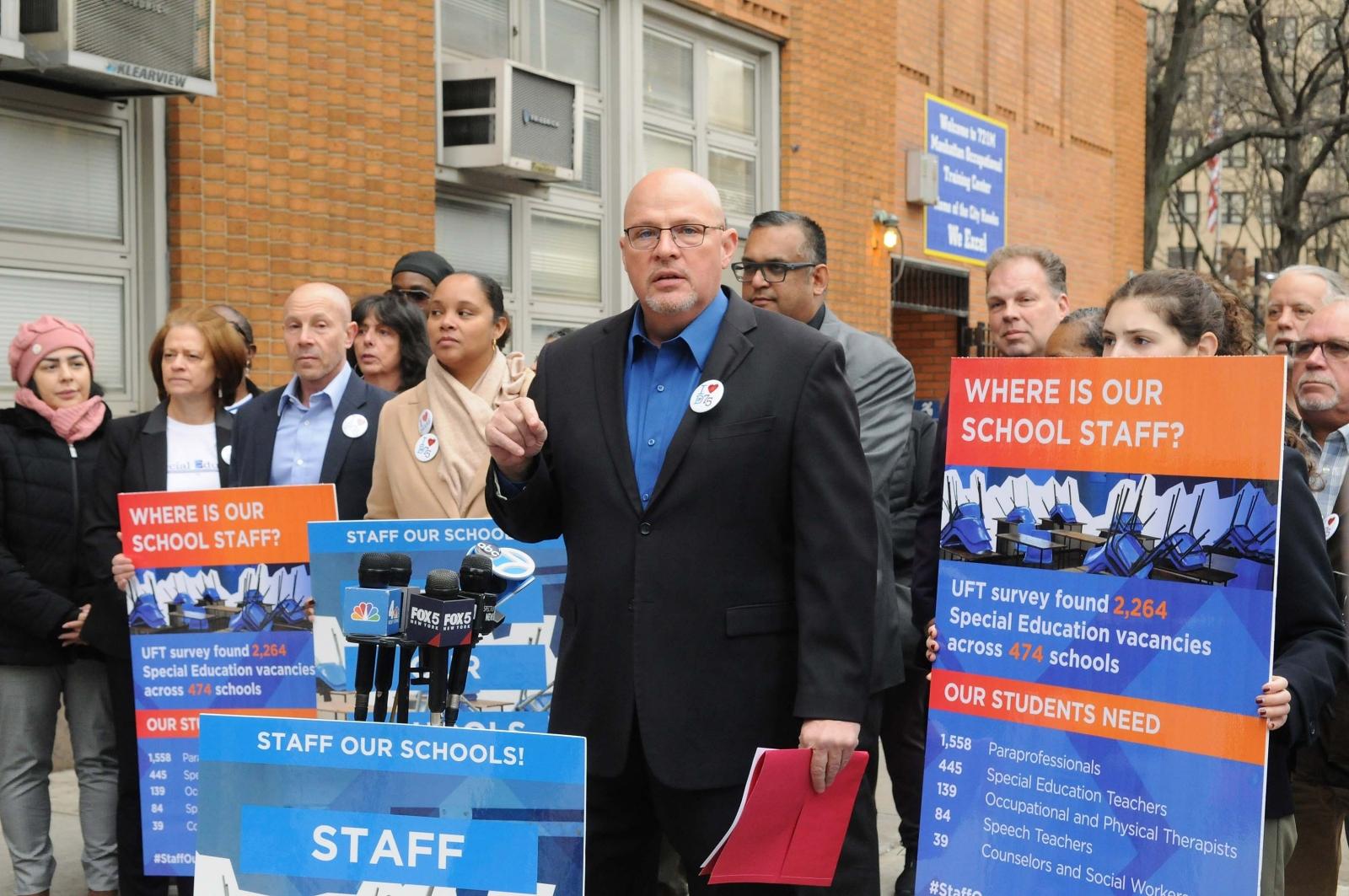
A union survey found more than 2,200 unfilled special education vacancies. The largest number of vacancies — 1,558 — were for paraprofessionals. The staffing shortfall had the greatest impact on District 75 schools, which educate students with the most severe disabilities.
“This shortage has resulted in a culture where students are not given services according to their needs, but rather they’re given services based on the personnel in the building,” said MaryJo Ginese, the UFT’s vice president for special education. “And that is a problem.”
New York City has made little progress since 2019, when it promised the state Education Department that it would fix special education, said Mulgrew, who called the appointment of city Schools Chancellor Melissa Aviles-Ramos “an opportunity for us to reboot the system.”
Jeffrey Andrusin, the chapter leader at P169 — a cluster of District 75 special education programs in Manhattan — said only three of the eight students in his class have their legally mandated paraprofessionals and just one of the five students who need occupational therapy is receiving it. His school, he said, has unfilled positions for at least 48 paraprofessionals, eight teachers and multiple related service providers. “At what point is this considered unsafe or unhealthy for our students and our staff?” Andrusin asked.
Paraprofessional Undrea Polite, the chapter leader at P369, a District 75 school in Brooklyn, said the school started the year with 26 vacancies for paraprofessionals and one for a speech teacher. Paraprofessionals and related service providers are the lifeline for special education students, she said. “We’re here to really help and service these students, and the DOE is not doing its part.”
Robert Roszkowski, the chapter leader at P993, a District 75 school in Queens, said 74 of 250 paraprofessional positions at his school were vacant in September. “Put simply, the shortage of paraprofessionals is dangerous,” he said.
Mulgrew said the DOE must fix the needlessly complex and lengthy paraprofessional application and approval process. He also pushed the DOE to increase paraprofessional pay.
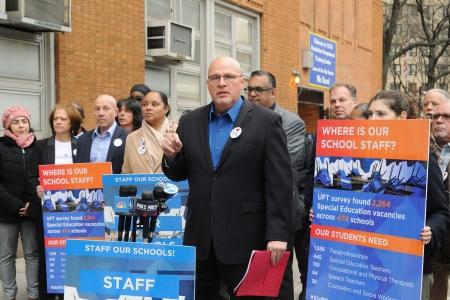
UFT President Michael Mulgrew (center) stands outside District 75 headquarters to call for the DOE to fill special education vacancies that resulted in 9,000 children not receiv- ing services mandated on their Individualized Education Programs.
The starting annual salary for paraprofessionals is about $30,000, said Priscilla Castro, the chairperson of the 26,000-member Paraprofessionals Chapter. “Our paraprofessionals are working multiple jobs,” she said. “Why? Because the system is broken.”
Thomas Ayrovainen, the chair of the Occupational and Physical Therapists Chapter, said his members agreed as part of the 2023 DOE-UFT contract to work an extra ninth period to serve more students. The DOE initially said it didn’t have a code in its payroll system to compensate them but then changed its story, he said.
“Now that we have the payroll code, they say they don’t have the funding,” Ayrovainen said. “At the same time, they’re outsourcing the sessions to private contractors.”
Parent Phillippa Bowden, the PTA president at P169 in Manhattan, said she hears from parents who are upset their children are not getting the services on their Individualized Education Programs. A mother of an autistic girl told her that the child had not received speech therapy this school year.
“I felt so badly for her that I was thinking, ‘Well, maybe my son could give up one of his speech sessions so the little girl could at least get one session per week,’” Bowden said. “How crazy is that?”
New York City Council Education Committee Chair Rita Joseph said she would hold a hearing so the DOE administration can explain to families why children are not getting services.
“These services are not a luxury, they’re not an add-on, they’re not a favor,” Joseph said. “They are legally mandated.”
