Growing scientists in Gowanus

Science teacher Amber Carlin-Mishkin of PS 118 in Park Slope instructs students about seedlings being grown in the school’s hydroponics lab. She sees her work as cultivating the next generation of conservationists and civic-minded adults.
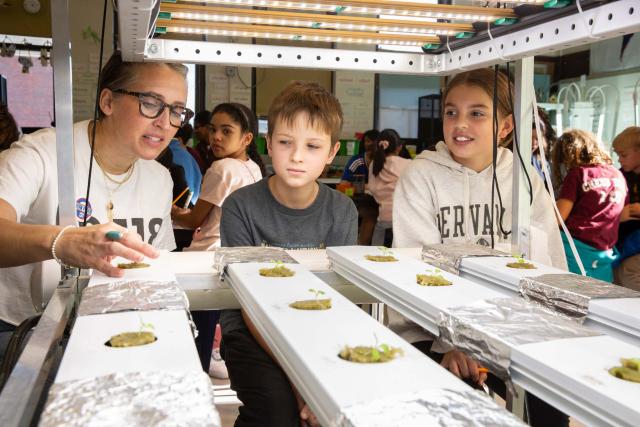
Amber Carlin-Mishkin doesn’t just teach science — she teaches her students to think like scientists. Through a new partnership with the Gowanus Canal Conservancy, the 5th-grade teacher at PS 118 in Park Slope, Brooklyn, helps her students view their own neighborhood as an ecosystem.
Thanks to a $7,000 City Council grant, which Carlin-Mishkin successfully lobbied for, students also learn how plants serve as “green infrastructure” that helps prevent flooding during extreme weather.
Her goal, she says, is to help students understand what she calls “systems of care” — the interconnectedness of the natural environment, the built environment, agriculture, water systems and the welfare of people who share a community.
“It’s about understanding the community that we live in,” she said.
Carlin-Mishkin teaches in PS 118’s expansive hydroponics lab, where students grow flowers, leafy greens, herbs, tomatoes and cucumbers. The students use the harvest to prepare meals, like pesto pasta, which the school donates to the local community fridge.
Hydroponics labs are increasingly common in public schools, but what makes this one unique, says Carlin-Mishkin, is how she connects traditional plant science to lessons about the students’ neighborhood and its residents. “The students grow things, they eat things, they make a lot of contributions to our community fridges,” she said.
On an October morning, an educator from the Gowanus Canal Conservancy delivered a lesson on green infrastructure in the nearby neighborhood of Gowanus. A slide on the area’s salt marshes and tidal inlets in the early colonial era led to lively student discussion about flooding in the school’s cafeteria during a recent storm.
“I saw water coming out of the sewer,” one student exclaimed, presenting an opportunity for the class to learn the terms “sewer shed” and “built environment.”
Students then became veritable urban planners and landscape architects as they brainstormed and sketched ideas for their ideal neighborhood park featuring green infrastructure, including plants and permeable pavement to manage rainfall as well as green roofs for the bathrooms (“to cut down on the smell,” one suggested).
Carlin-Mishkin supplements such in-class lessons with walking tours of the neighborhood and the Gowanus Canal, where students study the city’s water systems. “We map out the storm water drains in the area so that we understand the connection between rain and the canal,” she said. “They learn that we are responsible for keeping it clean and clearing away pollution and litter.”
Students also learn about New York City’s antiquated combined sewage-overflow system, which is a major cause of Gowanus Canal pollution.
Carlin-Mishkin sees her work as cultivating the next generation of conservationists and civic-minded adults. “It’s the larger idea,” she said, “of how important it is to take care of the space around you — and the people around you.”