
Members of District 16 in Brooklyn talk about Fixing Tier 6 and other UFT priorities with Assembly Member Stefani Zinerman (in red) in the Empire State Plaza Convention Center on UFT Lobby Day in Albany.

Fixing Tier 6, increasing state funding for public schools and boosting pay for child care providers were among the top priorities as about 1,000 UFT members and parents traveled to Albany on March 16 for the union’s annual Lobby Day.
After arriving at the Empire State Plaza Convention Center, participants heard from union leadership and elected officials before breaking into groups to meet with their local legislators ahead of the April 1 state budget deadline.
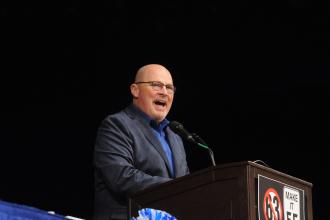
UFT President Michael Mulgrew urged members to press lawmakers on pension reform and school funding, emphasizing that the stakes extend beyond individual benefits to the long-term health of the education system.
“We’ve got a bit of work to do,” he told the crowd.
Participants made their priorities visible throughout the day, wearing “Fix Tier 6” bandannas, T-shirts and beanies and carrying noisemakers, clappers and maracas as they moved between meetings with legislators and their staff.
For those unable to travel to Albany, virtual Lobby Day events were held at school sites across New York City.
Mulgrew sharply criticized the creation of Tier 6 in 2012 under then Gov. Andrew Cuomo, arguing that its existence has made it harder to recruit and retain educators by requiring longer service (retirement without penalty at age 63 instead of the age 55 enjoyed by members in earlier pension tiers) and higher employee contributions.
That message was echoed in members’ meetings with lawmakers. Yona Adika, an occupational therapist at the Academy for Software Engineering in Manhattan, told Assembly Member Alex Bores that Tier 6 was introduced as a cost-saving measure at the expense of workers.
“What are we really saving by telling employees they have to work 40 years before they can retire with dignity?” Adika asked, referring to the fact that most educators begin their careers at about age 22, over four decades before age 63.
Funding equity was another central issue. Maureen McTigue, chapter leader at PS 117 in Queens, urged lawmakers to revise the state’s Foundation Aid funding formula to better support high-needs students, including those who are unhoused, in foster care, are English language learners or living with disabilities.
“They need more, and we’re ready to give it to them,” she said. “We just need the proper support.”
Dorothy McCarthy-Smith, a 1st-grade teacher at PS 54 in Queens, called on legislators to identify new revenue streams to fund public education, describing the out-of-pocket costs teachers often routinely absorb to buy classroom supplies themselves.
“I’m buying $50 worth of crayons or I’m trying to buy specialized notebooks and pencils,” she said. “We do what we have to do — but we need everyone to contribute for these kids.”
In addition to Mulgrew’s remarks, participants heard from state Attorney General Letitia James and several key legislators, including Senate Education Committee Chair Shelly Mayer and Senate New York City Education Committee Chair John Liu. Mayer told attendees that momentum is building in the Senate for Tier 6 reform but that lawmakers still need to be persuaded.
“We need your help,” she said, “because we have people to convince.”
Delegations raised additional concerns, including universal early childhood education, higher wages for family child care providers and compliance with the state’s class size law.
William Smith, a Manhattan-based education advocate who attended with parent groups, called for increased state investment to help schools meet those requirements.
“More capital funding,” is needed, Smith said, to meet class size mandates and better reflect the actual cost of educating students in New York City.
In addition, UFT Teacher Center representatives highlighted the program’s role in supporting educators. In separate meetings, site coaches Ari Feldman and Angela Metzler emphasized that the 203 UFT Teacher Center sites help improve teacher retention by providing mentorship and professional development.
“We shared that retention is a real issue, especially in the Bronx,” Metzler said. “Teacher Centers help combat that” by giving educators the support they need to stay.
















Members are the true MVPs