UFT solidifies class size funding
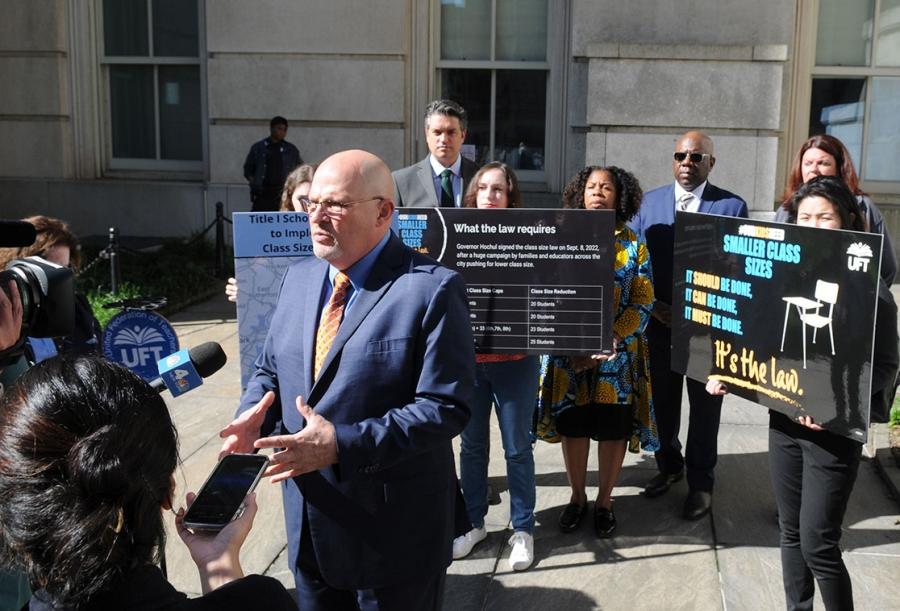
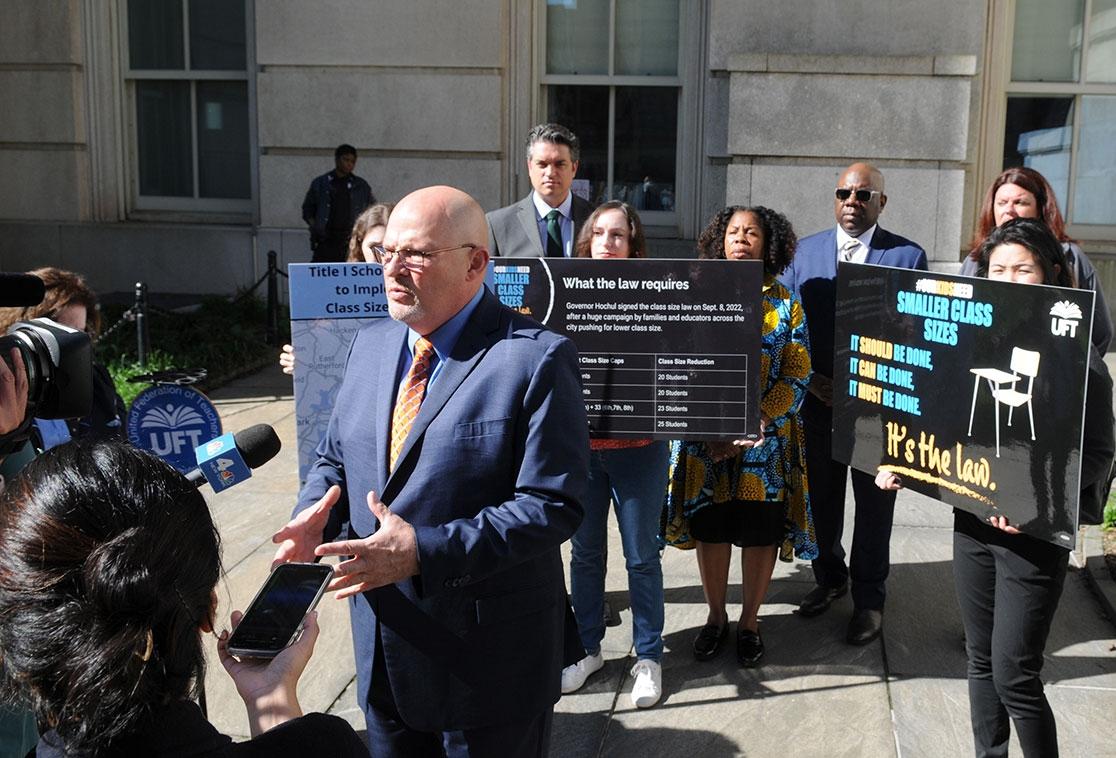
UFT President Michael Mulgrew, at a May press conference outside DOE headquarters, points out that more than 800 high-needs schools have the space now to reduce class size in September.
| Grade Level | Current Contractual Limits | New Law Limits |
|---|---|---|
| Kindergarten | 25 | 20 |
| 1st - 3rd grade | 32 | 20 |
| 4th -8th grade | 32 (4th and 5th) 33 (6th - 8th) | 23 |
| High school | 34 | 25 |
| Timeline: The new class-size caps are being phased in over five years. In September 2023, 20% of all NYC classrooms had to be in compliance with the new law. Another 20% of classrooms must be in compliance each school year by 2028, unless they receive a waiver. | ||
The push to ensure New York City implements the class size law gained new momentum this spring after state lawmakers included a provision in the state budget requiring the city to fund class size reduction in individual schools so they can all meet the law’s 2028 deadline.
“The whole false narrative that principals have to make a choice has been blown to pieces,” said UFT President Michael Mulgrew at the UFT Delegate Assembly on May 22. “No, they don’t. Schools get to maintain what they have, and they get additional money solely for the purpose of reducing class size.”
The city Department of Education’s draft class-size implementation plan for the coming school year, which it released in May, includes $182 million for schools to reduce class sizes for the coming school year.
The law, which was adopted in 2022, limits class sizes to 20 students in kindergarten through grade 3, 23 in grades 4–8 and 25 in high school. The new caps are to be phased in over five years. The DOE met the 20% requirement for the current school year because enough classes were already beneath the new limits. The minimum number of classes that must be under the new size limits increases by 20% each year over the next four years.
A UFT analysis found that 856 Title I schools, which enroll more than 300,000 students, have enough space to lower class sizes now but need funds from the city to hire additional staff. The union estimates that the DOE would need to hire about 3,000 additional teachers in these schools to meet the class size limits. The first-year cost would be roughly $180 million, the union calculated.
At a news conference outside DOE headquarters on May 7, Mulgrew called on the DOE and the city to stop playing games and start supporting schools as they do the hard work of identifying available space and hiring additional staff.
“Let’s get started with the schools that we know could come into compliance immediately starting in September if we do this right,” Mulgrew said.
Ten days later, the UFT activated its chapter action teams to educate staff and families about the new law and asked school chapter leaders to hold a consultation meeting with their principal to find out what staffing needs or space barriers they faced. The union also asked members to speak at one of five borough-based public hearings on the DOE’s draft plan in late May.
Language in the new state budget allows the state to withhold education aid from New York City if each school does not receive adequate funding to comply with the law, and it makes clear that the city cannot use state or federal money to supplant, rather than supplement, local funding.
In addition to providing an overview of the law, chapter action teams are dispelling myths about it. Students will not be turned away from coveted high schools with high enrollment. Schools that are short on space can get exemptions while they develop plans to expand capacity, he said.
“Not a single child will be denied access to their school because of the class size law,” he said. “If the school is overcrowded, let’s start developing a plan now. There is flexibility built into the law: A school doesn’t have to come into compliance all at once.”
Schools will not have to choose between reducing class size and offering popular programs, either.
“If you have a great art program, you keep your art program,” Mulgrew said, “and we will work with you to figure out how to get to a place where your school and the children in your school have the benefits of lower class sizes.”