Stop shelving school libraries

Libraries are the "heart and hub" of any school, providing students with books, educational resources and technology tools.
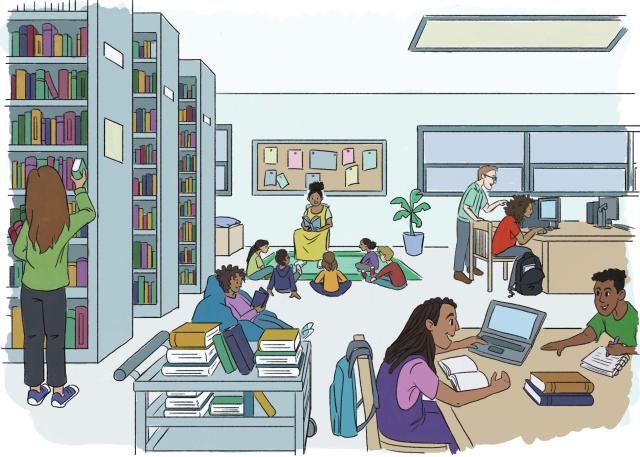
Perhaps, like me, you have fond memories of your school library. Maybe your class visited to check out books, or the school librarian taught you how to find resources or conducted a read-aloud. Maybe you were first exposed to technology tools there.
Sadly, those experiences don’t exist for many students today.
The UFT pushed for a current New York State law that mandates a library space in every school and requires every secondary school to have a certified school library media specialist. But enforcement has been lax. Approximately 30% of New York City schools don’t have libraries, and there are only 250 certified school librarians throughout a system with more than 1,800 schools, according to DOE data.
“The UFT’s position is there should be a certified librarian in every school library, K–12, not just secondary schools,” said UFT Special Representative Joseph Colletti, who is the union’s liaison to school librarians.
School libraries are needed more than ever. With the citywide implementation of NYC Reads in elementary schools this year, literacy programs could be bolstered by robust school libraries. Several research studies have shown that schools with certified librarians and library programs had significantly higher gains in reading test scores across grade levels.
“Reading is like any other skill,” said Rachel Chapman, the New York City School Librarians’ Association’s 2023 Librarian of the Year and the school librarian at the George Westinghouse campus in Brooklyn. “We don’t expect our basketball team to go play games without practicing. We can’t get better at writing and reading if we’re not practicing.”
Stephanie Rochester, the librarian at PS 189 in the Bronx, sees the library’s impact on student literacy and vocabulary. “I’ve been doing a lot of storytime and picking books with rich language, and I hear the kids using those words,” she said.
Rochester also works hand-in-hand with classroom teachers so she can reinforce subject matter and specific skills by “having it echoed in another space.”
Librarians can also help co-teach, plan and develop projects with teachers. “Teachers have so little time and a thousand reasons to not embark on a special project,” said Chapman, who said that librarians can “help classroom teachers make their ideas a reality.”
Brian Cheng, the librarian at PS 229 in Queens, sees his school library as a special place to spark and sustain the love of reading.
Cheng has made his school library more accessible by “reaching kids where they are,” he said. He has created a “judgment-free” place where students are encouraged to read in any format or at any level they wish. The goal, he said, is to make the students comfortable with a book and “just get them reading.”
The PS 229 library has a new Spanish-language section this year. “Students need literacy in their own language,” said Cheng.
Cheng’s strategies are working. A group of students regularly comes to the library first thing in the morning to both drop off and check out new books.
The lack of a school library has a disproportionate impact on students at high-poverty schools, who are less likely to have access to libraries and computers outside of school.
But access to technology is one thing, and teaching students how to use technology wisely is another, said Roy Rosewood, the librarian at the HS for Construction Trades, Engineering and Architecture in Queens. A school librarian who is trained to address digital and information literacy is invaluable, he said.
With the many purposes it serves and many needs it meets, the school library should be an integral part of every school.
“A library should be the heart or the hub of a school,” said Rochester. “This space takes on a life of its own. It becomes a resource for students, for staff, for parents.”