9/11: UFT remembers 25 years later

Murry Bergtraum HS students created this artwork, “Untitled,” in the aftermath of 9/11 from the book “The Day Our World Changed: Children’s Art of 9/11” by Robin F. Goodman, Ph.D., and Andrea Henderson Fahnestock.

9/11 was a defining moment, a day that marks a “before” and an “after.” That morning, UFT members were met with the unthinkable but succeeded in safely evacuating all 9,000 students near the World Trade Center without injury. They ensured that all 1.1 million students around the city made it home safely while transportation was halted citywide, roads and bridges were closed and phone service was spotty. Schools in the lower Manhattan “exposure zone” were temporarily relocated — some for a few days, others for months.

Murry Bergtraum HS, where Sandy Scragg taught in 2001, when it was in the shadow of the Twin Towers.


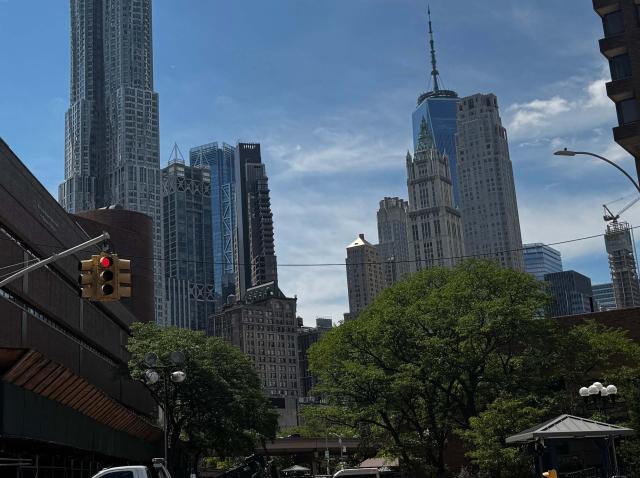
Murry Bergtraum HS, where Sandy Scragg taught in 2001, now has a view of the Freedom Tower.
“On that horrific day, our members stepped up to protect their students and worked together to make sure everyone stayed safe,” said UFT President Michael Mulgrew. “Commemorating this 25th anniversary makes us stop and reflect on the lives we lost but also remember how we took care of each other that day, and how we continue to take care of one another as fellow UFT members and New Yorkers.”
Everyone who was in New York City on Sept. 11, 2001, has a personal 9/11 story, myself included. I was an English teacher at Murry Bergtraum HS in lower Manhattan at the time.
That day, I emerged from the train and walked through the World Trade Center, as I did every morning at 7:50. During my first-period class, we heard a loud boom. Working downtown, you learned to take noises in stride. I assumed there was construction nearby and dismissed it. Immediately afterward we heard sirens — with our school located next to One Police Plaza, you got used to hearing those, too.
But on that day, the sirens never stopped.
I was lucky to get out of there alive, but maybe never fully intact again. I shudder when a plane seems to be flying too low. I don’t wear heels to work in case I need to run. And when I look at the skyline, sometimes I still expect the Twin Towers to be there.
Many things went missing afterward — people, buildings, our well-being. But not our dignity, not our resilience. I’ve always been a proud New Yorker, but never more than in the aftermath of 9/11, when we showed the world the meaning of humanity. Of everything I’ll never forget, that’s what I try to remember the most.
— Sandy Scragg,
UFT Digital Content Manager
former English teacher, Murry Bergtraum HS,
Manhattan
I was 22 years old and a New York City Auxiliary Police Officer. I was working out of the 13th Precinct [in Manhattan]. As we stepped out of the stationhouse, the first tower fell. Everyone was mobilized.

Seth Gilman, as a young police officer in 2001.

I would attend 19 funerals for friends, people I knew and strangers who wore a uniform similar to mine and who were in that way related to me.
When the towers fell, I was in the process of deciding whether to pursue a master’s degree in education. I have taught for 23 years now and an entire generation has passed. My friends who perished that day are still in my mind. I teach my students about them and that keeps those memories alive. I am their living legacy. It is my sacred duty to continue to speak about them until there is no longer air in my lungs.
And so we remember, we reflect and we teach others about what happened that day and how we, as humans, all came together to help, later to heal and truly, if only for a brief second in history, were united as one.
— Seth Gilman,
Chapter Leader
HS for Teaching & Professions,
The Bronx
I was a science teacher at the HS for Leadership and Public Service, located less than 500 yards from the South Tower, the second to be hit by a jet but the first to come down. We were so close, our building officially became part of Ground Zero. At the time, I remember fleetingly wondering, ‘Where, as humanity, do we go from here?’ And, I also wondered how we could help our students and staff recover.
What many folks don’t know, hear about, or associate this date with is how it forced many positive things to occur in the downtown community in its aftermath. I spent 16 more years at the HS for Leadership and Public Service, watching both our school and local community rebuild and bounce back.
The experience propelled me to create an environmental civics club, something that could help us improve the health of the community near our school. The first project we did was to bring students back to the very park we were evacuated to, Battery Park, less than three months later, to plant tulip bulbs donated from Holland. Our students soon learned that, rather than feel like victims who were helpless, they became survivors who became empowered.
— Daniel Fielding,
retired science teacher
HS for Leadership & Public Service,
lower Manhattan
Our principal became the captain of the ship. She put all of us in specific locations with specific jobs. Everyone in the school came together to help each other.
I received a phone call that came into the school’s main office from one teacher’s son who worked for Cantor Fitzgerald [a financial services firm headquartered at the World Trade Center that lost more than 600 employees on 9/11]. He told me to tell his mom that he loved her and that he was going up to the roof. Despite the tragic outcome, I felt so blessed that I was there to transmit that message as I know how much he wanted her to know.
— Diane Savattieri,
retired school secretary
PS 104,
Brooklyn
Sept. 11, 2001, marked my third day of teaching in a public school. Our corner gave way to a once perfect view of the majestic buildings. I left my classroom with another teacher to see for myself that the buildings were, in fact, aflame.
Later that morning, I returned to the corner to see what had transpired outside my confusing world at 116 W. 11th St. There, I saw hundreds of New Yorkers lined up to give blood at St. Vincent’s Hospital. And I saw parents, children and passersby standing tearful and motionless. The Twin Towers were gone.
— Nancy S. Wahl,
teacher
PS 41,
Manhattan
One great tragedy was the loss of the entire unit of 11 men from the fire department across the street. I had students from my illustration class create their interpretations of the word “hero,” which resulted in a spectacular book that we presented to the fire department.
We had faculty meetings dealing with the crisis. Three of our students lost parents. For months, the neighborhood looked like a war zone. There were armed members of the National Guard on Amsterdam Avenue. Military helicopters flew overhead for many months. Our lives were never the same again.
— Elana Amity,
retired art teacher
LaGuardia HS of Music and Art and Performing Arts,
Manhattan
We’re a small school and a small community, and a very caring community, so many students still stay in touch. We were a real family at that time. Because of the theme of the school, students were doing a lot of reading and writing. The kids were allowed to write about 9/11, they had to process it. Then they really got into what they were doing and they were writing about it all the time. Many of the students later became journalists or writers.

The Freedom Tower as seen from the former site of PS 150.

For months afterward, we had to stay inside. Our plaza, which used to be the center of the school, was off limits after 9/11. We couldn’t go out onto our plaza. That’s how “Mad Hot Ballroom” [the 2005 documentary film about the citywide ballroom dancing competition our kids participated in] started. So I guess there’s some silver lining.
— Christine Walford,
school secretary
PS 150,
lower Manhattan